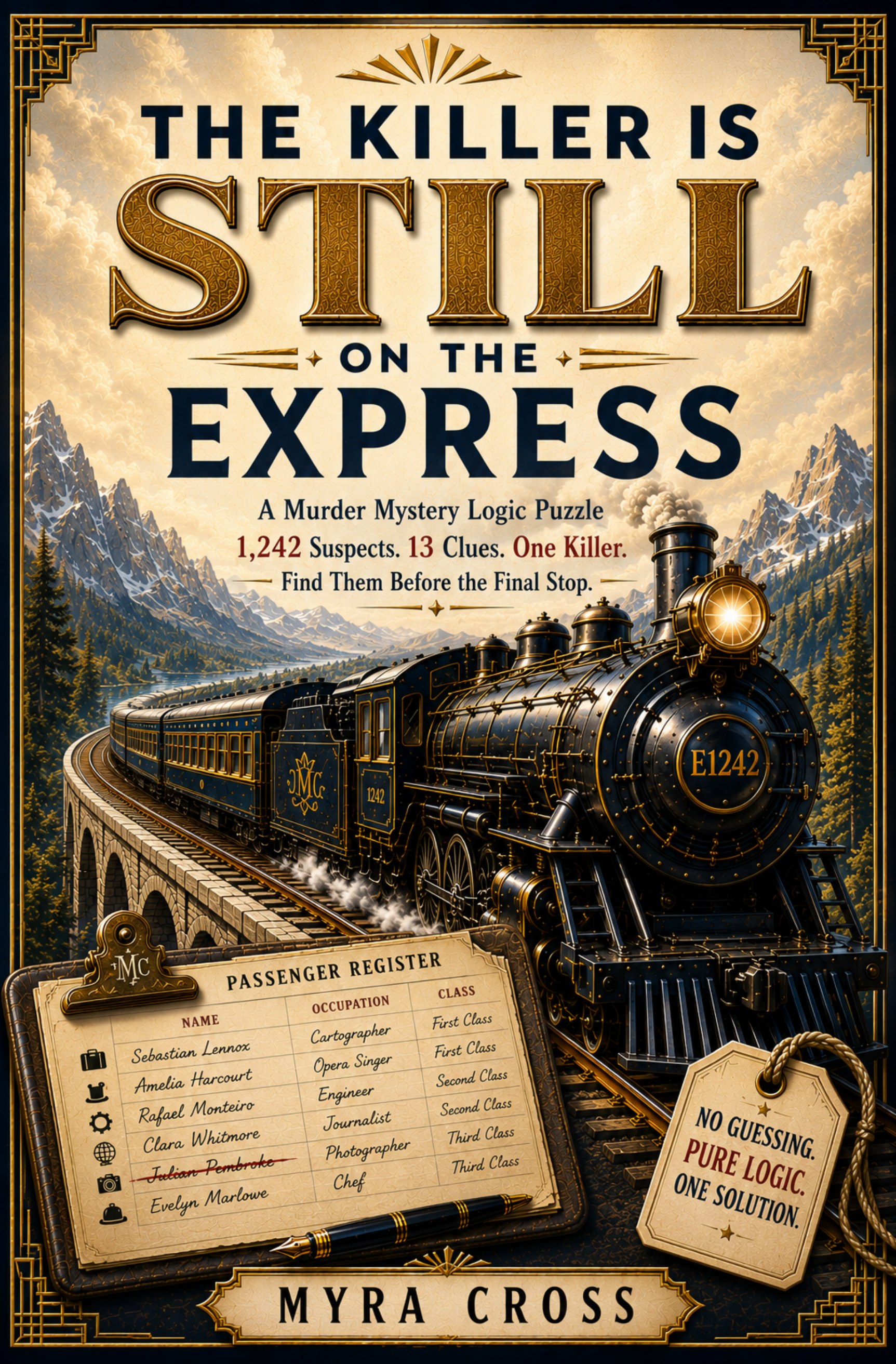
Walter Pryce was found in the dining carriage of the Highland Flyer — solicitor, settlement documents, and a secret he had never had the chance to raise. Beatrice Calloway, the railway's chief clerk, has left thirteen clues. Each one is true of the killer. Each one is true of no one else.
Can you find the killer before the train reaches Wrenfield?
What Beatrice left behind.
EXAMPLE CLUES
"The killer did not travel Third Class."
"The killer is not a Solicitor."
"The killer's surname contains exactly seven letters."
The full list of thirteen clues is inside the book.
The book does not contain the solution. This page does not either — until you tell it a name.
HAVE YOU FOUND THE KILLER?
Checked locally in your browser. Never sent anywhere, never stored, never in the page source.
Apply the wide clues first. The first four clues eliminate large groups at once — use these before moving to clues that require checking individual names closely.
Work through the Ledger page by page. Go from the beginning to the end systematically. Don't jump around — it's easy to miss a name if you skip sections.
Keep your crossings clear. When a clue eliminates a name, cross it out clearly. When you're down to a handful of names, re-check each one against every clue from the start.
Some clues ask you to look at the names surrounding your suspect. Look at the entries directly above and below in the Ledger — not just the name itself. The Ledger is one continuous list, so "directly above" means the entry immediately before, even if it's on the previous page.
Don't rush the final clues. The last few are the most precise. Take your time — the killer is hiding in the details.
Does the book include the solution?
No. The solution is not in the book. Use this page to verify your answer once you have one.
Does Y count as a vowel?
No. For any clue involving vowels and consonants, only A, E, I, O, and U are vowels. Y is always a consonant.
For clues about passengers "directly above" or "directly below" — do I look across pages?
Yes. The Ledger is one continuous list. Directly above means the entry immediately before it — even if it sits at the bottom of the previous page.
For the "shared letters" clue — does it matter how many times a letter appears?
No. Write out the distinct letters of each name — each letter only once, even if it appears more than once in the name. Then count how many appear in both lists.
Are there any hyphenated names or middle names in the Ledger?
No. Every entry has exactly one first name and one last name. There are no hyphens, middle names, or titles.
What if I think I've found more than one name that passes all thirteen clues?
This should not happen — exactly one name passes every clue. Recheck each one carefully against both names.
I've been through the whole Ledger and no name passes all thirteen clues. What do I do?
Recheck the clues in order from the first. It's easy to misapply an early clue and carry that mistake forward.
Known corrections for this book are listed here by edition. If the first page of your copy shows an edition number, that tells you which edition you have. Otherwise, you have a first edition.
FIRST EDITION
No corrections reported yet.